We are fully booked and have an exciting programme of exhibitions and events for 2026 more information coming soon.
Be the first to know sign up to What’s On! our monthly gallery newsletter
Marcia X Clayton
21 October – 3 November
A Kind of Dignity
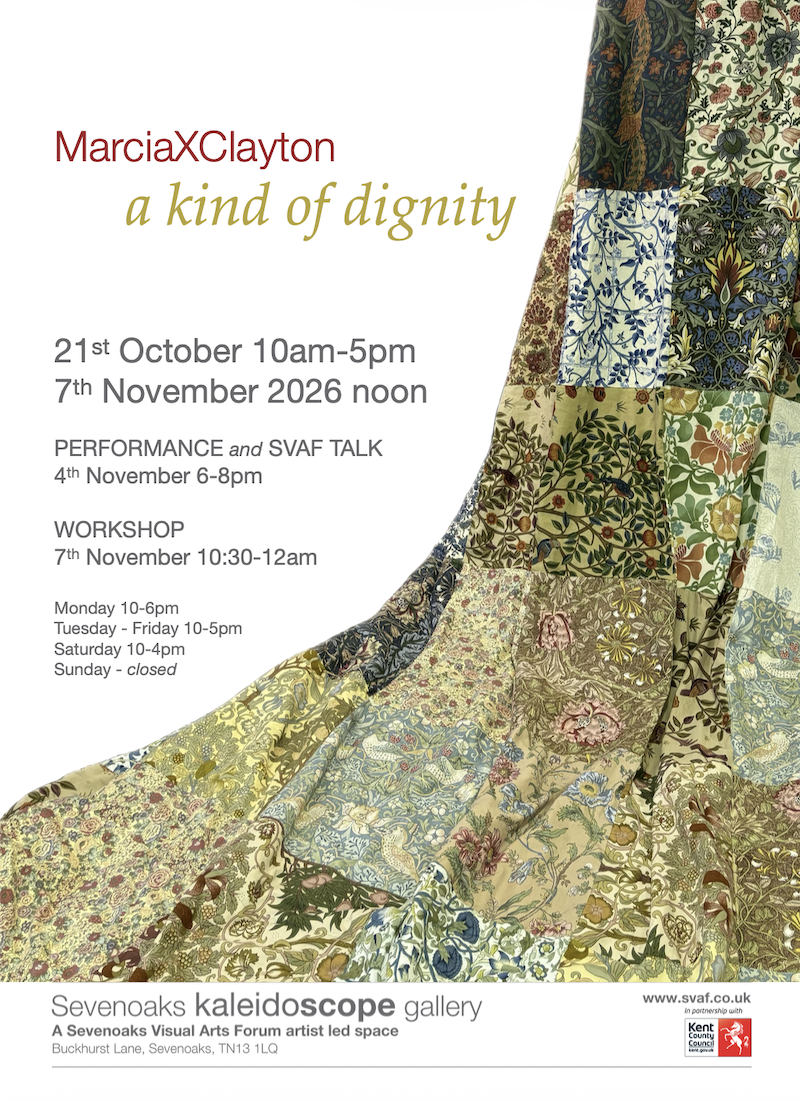
MarciaXClayton
a kind of dignity
“Stitching consumes dry matter — fabric, plastic, paper — like a corrosive acid. Corrosive because to stitch is to advance into the dense matter of time. What keeps me for hours on end, literally, stitching that fine thread which, when gathered together, generates a superior strength? I am a prisoner, but only through stitching does the possibility arise of touching, with the tip of the needle, a sense of freedom.” Edith Derdyk
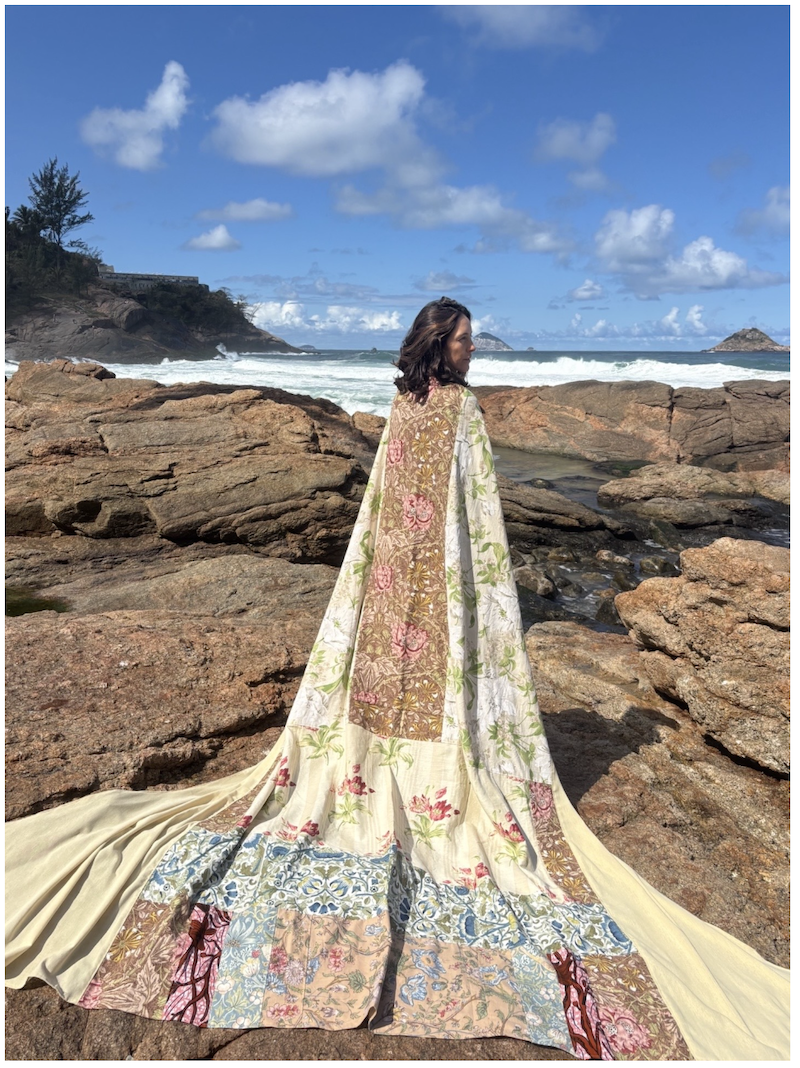
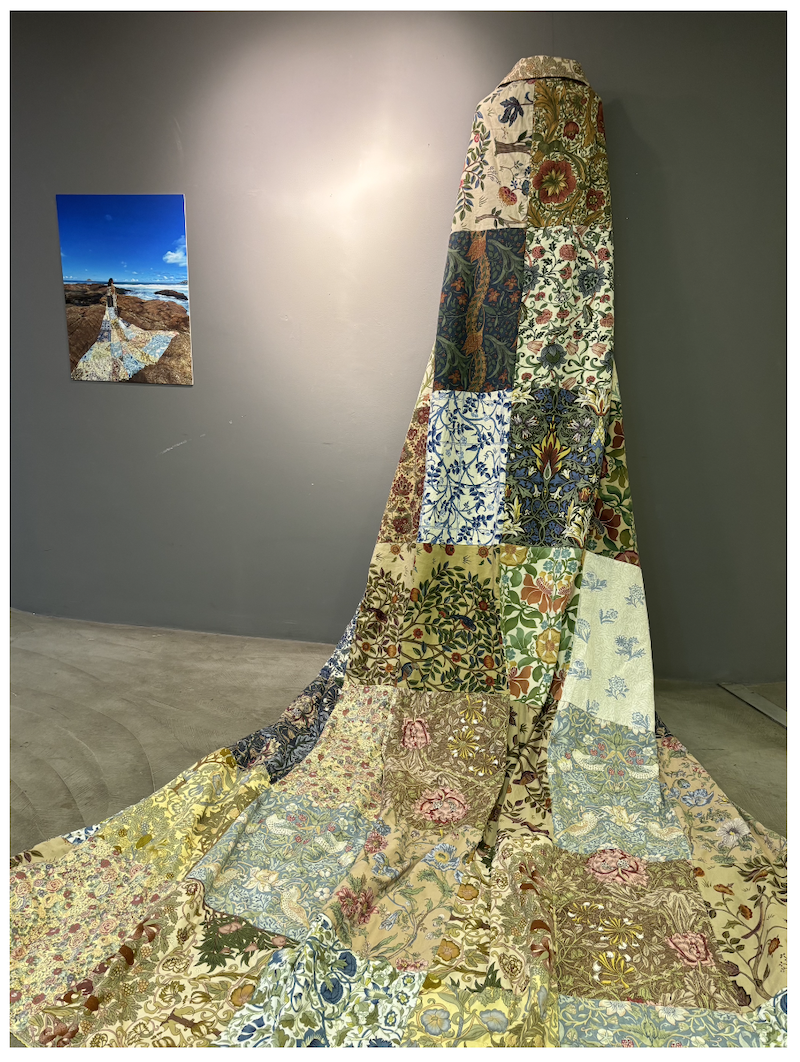
‘a kind of dignity‘ emerges as an act of self- preservation and resistance by the mature woman, frequently rendered invisible in societies shaped by ageism. The first Mantle, LIBERTY, was made from 45 scraps of Liberty fabrics acquired at an auction in a warehouse in Kent, England — most of them floral by William Morris
The textile work, however, extends beyond the matriarch, unfolding into mantles intended for subsequent generations: Manto GABI (for my daughter), Manto RENATA (for my daughter-in-law), Manto NINA (for my granddaughter), and Manto OLIVIA (for the newborn). Made from remnants of Liberty fabrics sourced from now-defunct textile shops, they vary in size and pattern, yet share the same symbolic weight — carrying protection, resilience, and dignity through time.
Thus, the mantles become a form of living inheritance, materializing what Maurice Halbwachs (1950) called “collective memory,” while also engaging with feminist practices in textile art which, as Rozsika Parker (1984) argues, re-signify sewing and embroidery as aesthetic and political gestures. What begins as fabric transcends the condition of clothing: it becomes a metaphor for resistance, intergenerational solidarity, and the persistence of female subjectivity in the face of erasure.
Memory, this bond lived in the eternal present because it is affective and magical, installs remembrance within the ritual of a video performance involving a family group; it takes root in space, gesture, image, and object. In contrast to history, an always problematic and incomplete reconstruction of what no longer exists, the project ‘a kind of dignity‘ brings together the dual and paradoxical aspects of memory and my artist’s life. The LIBERTY patterns not only represent a connection to the British past through a marriage, but also engage with the semantic meaning of “liberty,” following the dissolution of that marriage. The way of continuing this female lineage, formed across the generations during this long union, took the form of the textile object: the mantle. And the mantle, in turn, connects with the word “texture,” which, beyond the interweaving of a fabric, alludes to the harmonious sound of a group of voices, creating a poetic space written by women, whether through heterotopic weaving or through the configuration of a collective.
Thus, when confronted with the images of the works presented, we perceive the women from behind, contemplating the sea. Because they pose with their trains, we might mistakenly associate them with contemporary imagery — that of photographing oneself, as is common on social media, highlighting the body in a suggestive manner. However, when transported into an artistic context, this gesture takes on another dimension: that of an aesthetic construction in dialogue with nature and myth. It acquires symbolic layers, inviting us to reflect on how the female image has been re-signified and consumed over time.
When we think of myth, it is inevitable to evoke the figure of Circe — the island sorceress, a hybrid figure, half woman, half mermaid. Her power lies not only in beauty, but above all in her ability to enchant and subjugate men, putting their humanity to the test. Circe, like these female figures turned toward the sea, is the archetype of the mysterious and dangerous feminine. In an opposite yet complementary way, we find Penelope, embodying fidelity and cunning. While Odysseus is lost in distant seas, she weaves and unweaves, night after night, the mantle that becomes a metaphor for autonomy in the face of male pressure. Penelope does not allow herself to be captured: her waiting is not passive, but active, constructed through the ingenuity of a repetitive gesture that defies time and the suitors. Thus, between these protagonists, we encounter two faces of the mythical feminine: seduction that imprisons and patience that liberates.
Both are connected to the sea and stand at the threshold of the unknown, like we, women, portrayed from behind before the vastness of the ocean — at times as sirens who fascinate, at times as faithful weavers who resist.
MarciaXClayton Rio de Janeiro 2025
MarciaXClayton
a kind of dignity
The mantle precedes clothing. Before dressing a body, it dresses a condition. Throughout history, few objects have accumulated such symbolic density. The mantle protects, distinguishes, conceals, reveals, confers authority, and, at times, transforms the one who wears it. Kings were crowned beneath ermine mantles; priests wrapped their bodies in ceremonial fabrics; pilgrims journeyed beneath worn capes; mothers sheltered their children beneath open cloth as a refuge. Between the sacred and the everyday, the mantle became a symbolic technology of humanity: a supplementary skin capable of transforming vulnerability into belonging, anonymity into identity, the body into presence.
Royal mantles were never merely garments: they are instruments of legitimation. In Marcia’s work, however, a remarkable inversion takes place. The power emanating from her mantles comes neither from the State, nor from religion, nor from aristocratic lineage. It is born from lived experience — from motherhood, from the passage of time across the body, from the memory of a family of women. The artist borrows the visual grammar of royalty and ceremony — the gesture of investing, crowning, and protecting a community beneath a single piece of fabric — and shifts it entirely into the realm of affection. If the royal mantle distinguishes those who stand above, Marcia’s mantle distinguishes those who have survived, who have cared, who have passed something on, sewing protection for the women who come after them. This is not a matter of patrimonial inheritance, but of affective inheritance, something transmitted through gesture.
Marcia’s mantles are made from Liberty fabric — the celebrated London textile known for its English reinterpretation of Indian chintz — while their lining is made of chita, a Brazilian fabric whose origins can be traced back to the same Indian matrix as the outer print. This choice is not decorative: the fabric visible on the outside carries a colonial and commercial journey; what remains inside, next to the skin, carries resistance and Brazilian DNA.
The procession proposed, with her descendants, differs from a genealogical tree that fixes people in place — each name pinned to an immovable branch. The mantle, by contrast, circulates — it can pass from body to body, change temperature, absorb the gesture of the person who wears it before being passed on to the next generation. It is a mobile, affective genealogy, as fluid as life itself. Each generation receives a different mantle and, with it, a responsibility: the mantle marks a passage from one state to another, as in rituals, coronations, and theatre. In Marcia’s works, it marks other transitions: from wife to autonomous woman, from mother to grandmother, from individual experience to collective inheritance.
It is here that the word species, in the title of the exhibition, acquires its full force — MarciaXClayton is speaking of the human species. Our dignity may lie precisely in this shared condition: in our capacity to continue even when vulnerable, to transform memory into possibility, to acknowledge what constitutes us without ceasing to imagine who we might yet become.
Denise Araripe Rio de Janeiro August 2026
MarciaXClayton
a kind of dignity
Biography MarciaXClayton
1957 São Paulo/Brasil
Lives and works in Rio de Janeiro (Brazil) and Kent (UK)
Marcia’s interest in art was inspired by a sculpture workshop at Tate Gallery/Britain (London), in the eighties, followed by an art residency with the British sculptor Nigel Konstan at the Verrocchio Art Center in Casole D’Elsa (Italy 1998). In the following decade in Rio de Janeiro, she studied at EAV – Parque Lage School of Visual Arts, Atelier da Imagem (school of photography and video) and was a member of the printmaking group Projeto Impresso. Back in London, she attended the course ‘How to be a curator’ at Central St Martins UAL (London 2019).
From 2017 to 2022, Marcia acted as curator and gallery owner of Espaço MarciaXClayton, turning her residence into a gallery. Around a hundred local artists exhibited in the 11 shows she hosted. She had two poetry books published: DUBLINIA, poems and prints (2012) and FRESTA (2019), jointly with the poets Daisy Justus, Gilda Lima and Margarida Corção.
Marcia participated in many art exhibitions in Brazil and abroad, and is also in private collections and art institutions. In 2021, her solo exhibition BORDERLINE was held at Bermondsey Project Space (London). In 2025, in Pavia (Italy) the artist was in a group exhibition in homage to Italo Calvino. In August 2026, ‘a kind of dignity’ was presented in Rio de Janeiro (Brazil) for the first time in an individual show. In September 2026, participated in an artist residency in Italy, CASA_residência.residenza_VIVA.
In 2024, the artist completed the social sculpture project POSTING/INFINITY and installed the public environmental artwork IINFINITY in Greatness Recreation Ground, Sevenoaks, England.
Her works traverse various mediums using language as displacement experience, question gender and identity issues, and evoke alternative force fields for the human condition.
Sevenoaks Art Club 125 Annual Exhibition 2026
Brushworks
11 – 21 November 2026
Sevenoaks Art Club anniversary exhibition to benefit local charity.
This year Sevenoaks Art Club celebrates 125 years of creativity, in collaboration with Hospice in the Weald and supported by Sevenoaks Town Council.
In 1901, three Sevenoaks ladies founded Sevenoaks Art Club. The club history is somewhat ‘sketchy’, but for a while, possibly during the 1930s and 1940s, the name of the club evolved into the Sevenoaks Arts and Crafts Society and then at some point, returned to the original Sevenoaks Art Club. From articles and adverts which have appeared in the Sevenoaks Chronicle over the decades, it is evident that there was a long tradition of holding annual exhibitions which has continued to the present day, showcasing the artistic talent of the Sevenoaks Art Club.
125 years from its foundation, Sevenoaks Art Club is thriving. Meeting fortnightly and led by visiting artists, club members enjoy a programme of creating art in different mediums across a variety of subject matter. In the summer months we paint outside at local venues. The club welcomes artists from all levels of experience and club members enjoy making art together in our informal and sociable meetings. Hopefully, the founding members would be pleased with how the club has continued to encourage Sevenoaks’ artistic community.
This anniversary year the club’s exhibition supports local charity Hospice in the Weald and most paintings will include a specified percentage donation.
The exhibition called Brushworks will be at Kaleidoscope Gallery, Buckhurst Lane, Sevenoaks TN13 1LQ from 11 – 21 November.